You noticed it as an absence. The obvious phishing thinned out this year, and one or two newsletters you actually like went quiet for a few weeks before coming back. Both are side effects of the same thing: the bulk-sender rules Gmail, Yahoo, and Microsoft rolled out are no longer a warning. They are enforced, permanently, and they are reshaping what reaches you.
Two years in, the Gmail, Yahoo, and Microsoft bulk-sender rules are permanent and enforced. Since November 2025 Gmail rejects non-compliant bulk mail outright with a 550 error. Compliant senders now reach the inbox about 89% of the time; non-compliant ones land in spam 22 to 34% of the time. Your inbox is the beneficiary.
What are the bulk sender rules in 2026?
The rules are the same SPF, DKIM, DMARC, and one-click unsubscribe requirements Gmail and Yahoo introduced in February 2024, now backed by hard enforcement across all three major providers. A bulk sender is any domain sending roughly 5,000 or more messages a day to personal accounts. The grace period is over.
The full ruleset, provider by provider, sits in our deep-dive on the Outlook and Gmail bulk-sender crackdown. This piece is the status update: what enforcement looks like now that the soft-launch window has closed.
The headline is the size of the gap between senders who comply and senders who do not. According to Bulk Email Checker’s 2026 deliverability report (May 2026), compliant senders average about 89% inbox placement, while non-compliant senders land in spam 22 to 34% of the time, three to seven times the baseline rate. The same report finds roughly 30% of bulk senders still fail at least one requirement, and the most common failure is the one-click unsubscribe header.
Why is Gmail rejecting emails outright now?
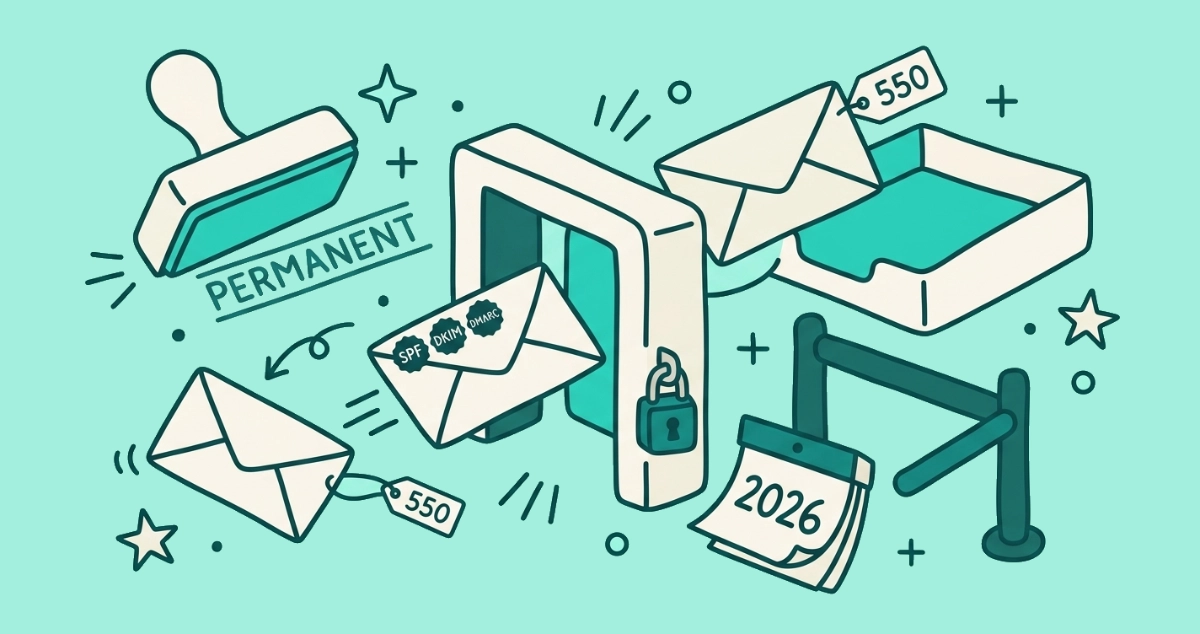
Since November 2025, Gmail no longer just filters non-compliant bulk mail to spam. It rejects the message at the server with a permanent failure, typically a 550 error. The mail never reaches the inbox, the spam folder, or any hidden label. It bounces back to the sender.
Google spent early 2024 through late 2025 in what the industry called soft enforcement: warnings, temporary deferrals, and spam-foldering. As documented in Red Sift’s account of Gmail’s enforcement ramp-up, that period closed in November 2025. Postmaster Tools now scores senders on a pass or fail basis, and partial compliance counts as failure.
Microsoft made the same move on its own timeline. It began enforcing on Outlook.com, Hotmail, and Live addresses on May 5, 2025, the step we covered when Outlook joined the crackdown. The three providers that carry most of the world’s personal email now demand the same proof of identity before a bulk message reaches you.
What changed in the DMARC standard in 2026?
In May 2026 the IETF published a modernized DMARC specification, RFC 9989 and its companions, replacing the original 2015 standard. Senders gained sharper tools. You gained nothing to do.
The update, long known as DMARCbis, retires the confusing pct tag and adds two new ones: t= for safely testing a stricter policy before turning it on, and np= for controlling mail from subdomains that do not exist, a common spoofing trick. Existing DMARC records keep working without a rewrite. The dmarc.org announcement of the new specification confirms the change moved DMARC onto the IETF standards track for the first time.
For an inbox owner the effect is indirect but real. The standard behind the rules is now mature and official, which makes it harder for a sloppy sender to hide behind half-measures. If the acronyms are a blur, our plain-English guide to SPF, DKIM, and DMARC walks through what each check actually does.
Why did some newsletters you like briefly vanish?
A sender you trust can fail an authentication check for a mundane reason, like a misconfigured DNS record or a switch to a new sending platform, and get rejected or spam-foldered until it fixes the setup. Under permanent enforcement that fix is now urgent, so the outage is usually short.
This is the uncomfortable side of stricter rules. The same 550 rejection that blocks a spoofed bank email also blocks a legitimate small publisher who forgot to align DMARC. Our piece on why legit mail gets flagged covers the specific ways a real sender trips the filters. The difference in 2026 is the stakes. A sender that would once have limped along in your spam folder now disappears entirely until it complies, which is why a favorite newsletter can go dark for a week and then reappear.
Does this mean less spam in your inbox?
Less of one kind. The rules crush spoofing, the mail that forges a real company’s domain to fool you. They do almost nothing to graymail, the newsletters and promos you once signed up for yourself.
A scammer posing as your bank now fails DMARC and gets rejected before you ever see the message. That is the phishing these rules were built to stop, and it is thinning out. A store you handed your address to in 2022 is a different story. It is perfectly authenticated. It passes every check. It keeps arriving because you are still on its list, not because it is breaking any rule. The crackdown makes your inbox safer. It does not make it emptier.
What these rules still leave on your plate
Authentication proves who a sender is. It never proves you wanted the mail. Clearing the subscriptions you piled up over the years is still manual work, one sender at a time.
The one upside for you is that the same rules forced bulk senders to build a working one-click unsubscribe, and the most common compliance failure in 2026 is exactly that header. When it is present, leaving a list takes one tap and the sender has to honor it. Email Unsubscriber reads those List-Unsubscribe headers across your whole Gmail or Outlook inbox, fires a real one-click opt-out for every sender that supports it, and runs the scan inside your browser, so your email content never reaches a server. It connects personal Microsoft accounts and Gmail; it does not support work or school accounts.
The rules cleaned up who is allowed to email you. Deciding who still should is the part that stays yours.