You open a promo from a brand you half-remember signing up for. The subject line lands a little too well. The copy reads clean, the offer is aimed straight at you, and it arrives right when you tend to check your phone. There is a real chance no human wrote a word of it.
Yes. By 2026 most marketing emails are at least partly written by generative AI. Salesforce’s State of Marketing report found 75 percent of marketers have adopted AI, and tools now draft subject lines, body copy, and send times automatically. AI rarely writes a whole email alone, but its fingerprints are on most of what lands in your inbox.
This is the sending side of the AI-in-email story. Its companion, AI email summaries in Gmail and Apple Mail, covers the reading side, where AI condenses the mail you receive. Here we look the other way, at the machines now writing the mail before it reaches you, and what that means for what you see, how often you see it, and what to do about it.
Are the marketing emails you get written by AI?
Increasingly yes, though rarely from a blank page to send button with no human in the loop. The more accurate picture is a marketer prompting a model for ten subject-line options, editing the one a testing system picks, and letting the platform decide when to send. AI does the heavy lifting; a person signs off.
The adoption numbers are no longer marginal. According to Salesforce’s tenth State of Marketing report, based on 4,450 marketers surveyed between October and November 2025, 75 percent of marketers have adopted AI. On the email side specifically, Litmus reported that 70 percent of email marketers expect up to half of their email operations to be AI-driven by the end of 2026, and it documented a 340 percent increase in generative-AI use across 2025 for copy, images, personalization, and testing.
So the honest answer is not “AI writes everything.” It is that AI now touches most commercial email at some stage, and the share of fully hand-written marketing mail is shrinking every quarter.
What does AI actually write in a marketing email?
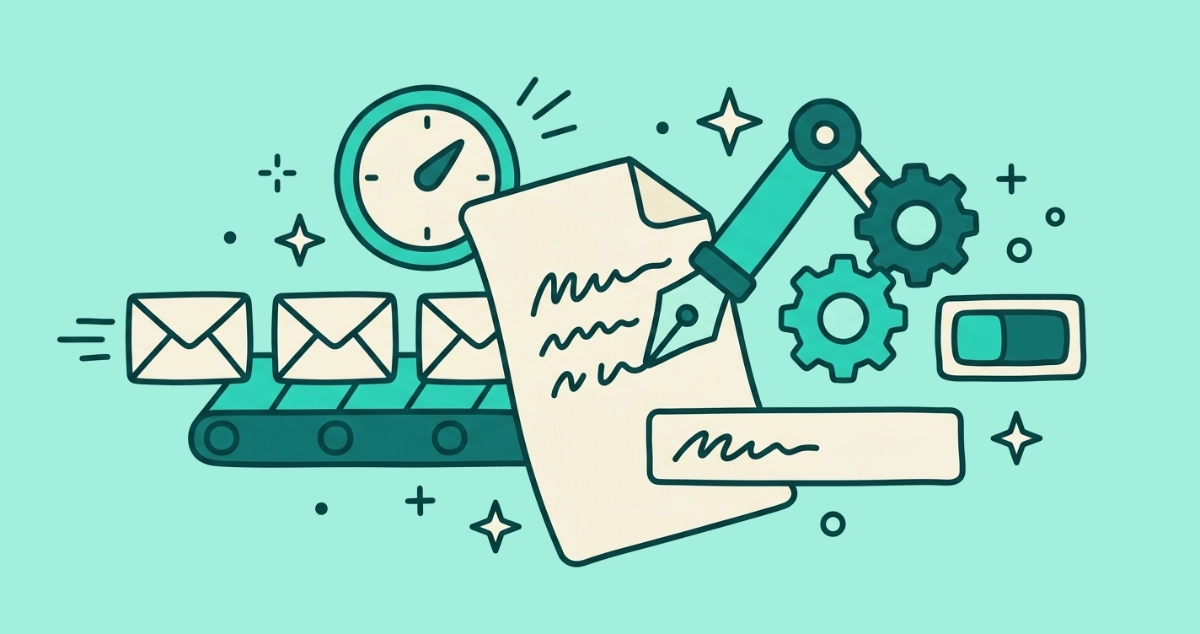
Four parts, mostly. AI has moved from a novelty to a default across the pieces of an email that drive opens and clicks.
- Subject lines. The most common use. A model generates dozens of variants, and a system tests and ranks them against your segment.
- Body copy. Product descriptions, promo blurbs, and calls to action. Litmus found roughly half of email teams planned to use generative AI for copy creation in 2025.
- Personalization. The tokens that make a message feel aimed at you: your name, your last browse, your city, sometimes the local weather, slotted in automatically per recipient.
- Send time. Not writing at all, but a model deciding the hour you personally are most likely to open, then queuing the send for that moment.
None of this requires the AI to write the whole email. It assembles and tunes the parts that move the numbers, which is exactly where a human copywriter used to spend the most time.
Do AI-written subject lines actually work?
Often enough to be worth it, because AI is good at the two levers that lift opens: personalization and relentless testing. A person writes one subject line and hopes. A model writes forty, learns which tone and structure your segment responds to, and keeps adjusting.
The personalization lever is old and well measured. Experian Marketing Services’ 2013 email study found that personalized subject lines drew 26 percent higher unique open rates than generic ones. What changed is scale: doing that by hand for millions of recipients was impossible, and now it is automatic.
The AI-specific results back this up. When eBay handed subject-line writing to Phrasee’s language model, a 2018 Econsultancy case study reported a 15.8 percent average lift in open rates and a 31 percent lift in clicks, worth roughly 700,000 extra opens per campaign. The model was not more creative than eBay’s writers. It just tested faster and never stopped learning.
Does AI mean you get more marketing email?
Probably, over time, as a side effect. The clearest reason is cost. When an email takes an afternoon to produce, a brand rations its sends. When a draft takes ten minutes, that brake comes off.
The production data shows the shift plainly. Litmus found that 62 percent of email teams needed two weeks or more to produce a single email in 2024, but only 6 percent did in 2025. A campaign that used to be a two-week project is now a same-day task. Cheaper output usually means more output.
That said, the trend is not uniform. Some sophisticated brands are using the same AI to send you less and better-targeted mail, a counter-move we cover in why smart brands now email you less. Either way, the polish rises. If your inbox already feels fuller each year, the broader numbers in our email overload roundup put figures to the feeling.
How can you tell if an email was written by AI?
Honestly, usually you cannot, and that is the design goal. Generative copy is built to read like a person wrote it, so treating “sounds like AI” as a reliable filter will fail you.
A few loose tells point that way without proving it:
- Uncanny personalization. The email references your exact last browse, your city, and today’s weather in a way no human team could hand-write at scale.
- Uniform polish. Every send is clean, on-brand, and typo-free, week after week, across dozens of variants.
- Formulaic subject lines. Curiosity gaps, your first name, and emoji placement that feel A/B-tuned rather than written.
- Precise timing. Messages that consistently land in your quiet 8 p.m. scroll rather than at a round marketing hour.
None of these is a verdict, and chasing them is a losing game. The reliable move is to stop judging the prose and judge the sender. If you do not want mail from this company, it does not matter who or what wrote it.
Is AI making your inbox more personal, or just more polished?
Mostly more polished, not more genuinely relevant. This is the gap the industry’s own data keeps exposing. Marketers adopted the tools faster than they learned to use them well.
Salesforce’s report framed it bluntly in its headline finding: 75 percent of marketers have adopted AI, yet many still use it to send one-way, generic campaigns. The technology can personalize deeply, but a lot of it is pointed at producing more of the same mail faster, dressed in cleaner language. For you as the recipient, that reads as a subtle upgrade in tone and a real increase in volume, without the mail actually earning more of your attention.
Which is the quiet problem with AI on the sending side. It makes unwanted email better at looking wanted.
What can you do about the AI-written flood?
Unsubscribe from the senders you do not want, and ignore how good the writing got. AI changes the quality and the frequency of marketing mail, but it does not change the one decision that matters: whether you want this company in your inbox at all. Deleting or muting a message only hides it, and the next AI-drafted send still arrives on schedule. Unsubscribing takes you off the list, so no amount of machine polish reaches you again.
The counter to AI-written email is not more AI. It is removing yourself from the list, which is a plain mechanical act. That is the job Email Unsubscriber was built for. It scans your Gmail or Outlook inbox in your browser, lists every subscription sender, and opts you out in a few clicks. It reads the standard List-Unsubscribe header, not your messages: we never read, analyze, or monetize your email content, and there is no AI reading your mail on our end, just a one-off payment and a cleaner inbox. You can see what it costs before you start.
The senders got smarter tools. Your best answer stayed simple. Decide who you want to hear from, and cut the rest loose in one sitting.