It is primary season, and your phone buzzes every few hours with “Can we count on your vote?” while your inbox fills with “FINAL NOTICE: the donation deadline is tonight.” You reply STOP to one, unsubscribe from another, and the next morning three more arrive from numbers and addresses you have never seen.
Reply STOP to political texts, since the FCC treats it as a valid opt-out and most reputable campaigns honor it. Use the unsubscribe link in emails when there is one, then mark the rest as spam. Political email escapes CAN-SPAM and many mass texts sidestep the TCPA, so these opt-outs are voluntary, not guaranteed.
This is a plain-language explainer of US rules, not legal advice. It stays out of party politics entirely and only covers how to make unwanted messages stop.
Why are political texts and emails so hard to stop?
They sit in a legal gap that commercial marketing does not. The two federal laws that force ordinary companies to give you a clean exit were written to cover commercial messages, and a campaign asking for your vote or your money is not selling a product.
For email, that gap is CAN-SPAM. For text messages, it is the way the Telephone Consumer Protection Act (TCPA) defines an autodialer. Both leave political senders with far more room than a retailer has, which is why the unsubscribe link and the STOP reply work less reliably here than they do on a store’s newsletter. The good news: the practical tools still work on the senders who play by the rules, and most established campaigns do.
Are political campaign emails covered by CAN-SPAM?
No. CAN-SPAM regulates only commercial email. The FTC’s CAN-SPAM compliance guide defines a covered message as a “commercial electronic mail message” whose primary purpose is “the commercial advertisement or promotion of a commercial product or service.” A candidate asking you to vote, volunteer, or donate is not advertising a product, so the message falls outside the law.
The consequence is concrete. A political campaign is not legally required to include an unsubscribe link, and it is not bound by the 10-business-day deadline that a retailer must meet. The link you often see in campaign email is there by choice, not by mandate. When a committee honors it, you are relying on their good practice, not on the FTC.
One edge case flips this. If a message’s main purpose is selling merchandise, a campaign store pushing hats and shirts for example, that email can qualify as commercial and pull CAN-SPAM back into play. For the wider map of how these rules differ by region, and how the EU treats political mail more strictly, see unsubscribe laws by country.
Do political text messages violate the TCPA?
Often they do not, because of how the messages are sent. The TCPA requires your prior express consent before a business texts your cell phone using an autodialer or a prerecorded voice. Campaigns learned to route around that requirement.
The workaround is peer-to-peer texting. A campaign loads a voter file, writes a script, and pays people to click send for each recipient one at a time. The FCC has said that a platform requiring a person to manually send each individual message is not an autodialer, so the consent rule does not attach. The Supreme Court narrowed the definition further in its 2021 Facebook v. Duguid decision, which held that an autodialer must use a random or sequential number generator. Political texts target a curated list of real voters, so they escape on that ground too.
The result is a gray area rather than a clear violation. A text blasted by a genuine autodialer without consent breaks the TCPA. A text a worker sent by hand from a voter list usually does not, even though it lands in your pocket looking identical.
How do I stop political campaign texts?
Work through these steps in order. Each one narrows the flow, and the first one handles most reputable senders on its own.
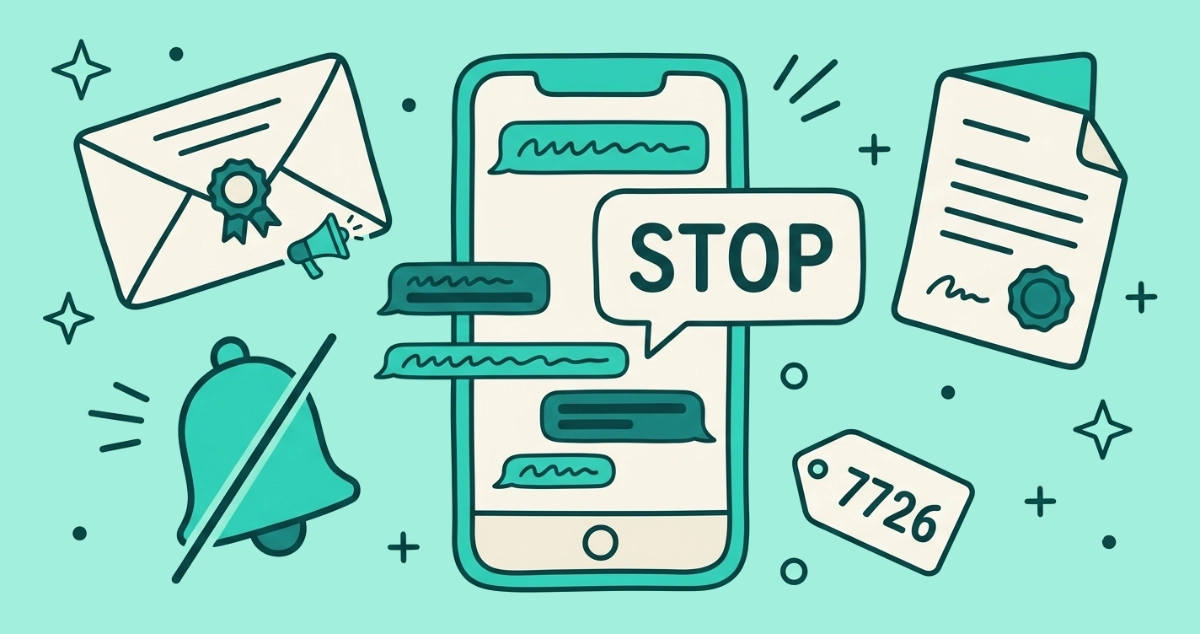
- Reply STOP. The FCC recognizes STOP, QUIT, END, REVOKE, OPT-OUT, CANCEL, and UNSUBSCRIBE as valid opt-out words. Send one and a compliant campaign stops texting that number.
- Do not engage otherwise. Replying “who is this” or “wrong number” tells the sender a real person reads the line, which can invite more. STOP is the only reply worth sending.
- Forward the text to 7726. Those digits spell SPAM. Your carrier uses the report to identify and filter abusive senders across its network.
- Block the number. Blocking stops that specific sender regardless of whether they honor opt-outs, though a new number can still reach you.
- File an FCC complaint. For senders who ignore a STOP, submit an informal complaint at fcc.gov/complaints with dates, the sending number, and screenshots.
After this sequence, the honest campaigns drop off quickly and the persistent ones become easier to block and report. Expect a trickle from new numbers, since a fresh sending line costs a campaign almost nothing.
How do I stop political campaign emails?
The email playbook is shorter, because your inbox provider gives you more leverage than the law does.
- Click the unsubscribe link if there is one. Most campaigns include it voluntarily, and honoring it is the fastest clean exit when they do.
- Mark the message as spam. In Gmail or Outlook, reporting spam trains the filter to divert similar senders before they reach you, which matters when no unsubscribe link exists.
- Build a filter. Create a rule that sends any future mail from that address straight to trash. This works even on senders who never offer an opt-out.
- Check the preference page. Some campaign platforms run several lists at once, so a “manage preferences” screen can switch off more than the single “unsubscribe” link would.
The expected outcome is a quieter inbox within a week for compliant senders, and a filter that quietly handles the rest. Because no CAN-SPAM deadline applies, marking as spam is frequently the tool that does the real work here. If you have already unsubscribed from ordinary companies and the mail keeps coming, your rights when unsubscribe fails covers the enforcement channels that do exist for commercial senders.
Why do I keep getting messages I never signed up for?
Campaigns rarely need your signup. They build contact lists from public voter files, commercial data brokers, petitions you signed, and past donations, then share numbers and addresses among allied committees and PACs. Each committee is a separate sender, so opting out of one leaves the others untouched.
That sharing is where a browser opt-out signal helps at the margin. It will not scrub your name from a public voter file, but switching on Global Privacy Control tells websites not to sell or share your personal data, which slows the data-broker pipeline that feeds a share of these lists. It is a long game, not an off switch, and it does nothing to the voter roll itself.
Can I report or take legal action if they will not stop?
You have real channels, though they favor the SMS side. Forward stubborn texts to 7726 and file at fcc.gov/complaints, which forwards your report to the sender, who then has 30 days to respond. For a text sent with an autodialer or prerecorded voice without consent, the TCPA lets you sue for $500 per message, or up to $1,500 if the violation was willful. Peer-to-peer texts sent by hand usually fall outside that hook, so they are far harder to pursue.
Two limits are worth knowing up front. The National Do Not Call Registry does not cover political calls or texts, a point the FCC’s own guidance on campaign calls and texts confirms, so registering your number does nothing against them. And the FCC’s 2024 order (FCC 24-24) that requires senders to honor a revocation within 10 business days, with the core rule effective April 11, 2025, applies to messages that needed consent in the first place. For the manual texts that never needed it, honoring your STOP stays a matter of the sender’s own policy.
Where an unsubscribe tool helps, and where it does not
An inbox cleanup tool solves the email half of this problem and none of the SMS half, and the honest version of that boundary matters here. Email Unsubscriber scans your Gmail or Outlook in your own browser, lists every sender still mailing you, and fires the real one-click opt-out on any message that carries one, including a campaign email that chose to include the link. Its “Still Emailing” flag then tells you which senders ignored the request, so the committees that kept mailing stop being invisible.
What it cannot do is override the law’s gaps. No app forces a political sender that CAN-SPAM does not cover to honor an opt-out, and no app touches text messages at all. What it does well is clear the far larger flood of newsletters, promotions, and retail lists surrounding the campaign mail, and keep a dated record of who honored your request and who did not. The scan runs on your device, we never read or monetize your email content, and it is a one-off payment with nothing to cancel. For the campaign texts, your phone’s STOP reply and the block button remain the tools that count.