A store you bought running shoes from once now texts you. A newsletter you used to read arrives as a WhatsApp message. A brand drops a glossy, branded card straight into your phone’s Messages app, complete with buttons and a product carousel. The marketing that used to pile up in your inbox is spreading to the channels you keep closest.
RCS and email marketing are two channels chasing the same goal: reaching you. RCS (Rich Communication Services) delivers branded, interactive messages to your phone’s texting app; email lands in your inbox. Marketing is shifting toward messaging for higher open rates, but email is not dying. It stays the biggest channel and the easiest one to opt out of.
What is RCS business messaging, and why are brands adopting it?
RCS is the successor to SMS, the carrier texting standard that upgrades plain texts into rich, app-like messages: high-resolution images, read receipts, typing indicators, verified sender names, buttons, and carousels. RCS for Business lets a company send those to your phone’s default texting app, badged with its name and logo instead of a random five-digit number.
Brands adopted it once reach and richness arrived together. The reach came from Apple. Apple added RCS to the iPhone with iOS 18 in fall 2024 and began rolling out RCS for Business in iOS 18.1 that October. Before that, RCS was Android-only, which capped its audience at half the market. After it, RCS reached nearly every modern phone. Google reported in May 2025 that more than 1 billion RCS messages are now sent daily in the US, up 80 percent since Apple’s adoption.
The richness is the other half. An RCS message can carry a product carousel and a Buy button; an SMS carries 160 characters of plain text. For a marketer, that is the difference between a link and a storefront.
RCS vs email marketing: how do the two channels compare?
Email reaches more people and hands you a clean, legally backed way out. RCS reaches you faster and feels more personal, which is exactly what makes it harder to ignore. Here is how the two line up:
| Criterion | Email marketing | RCS business messaging |
|---|---|---|
| Where it lands | Inbox (Gmail, Outlook) | Phone’s texting app (Messages) |
| Scale (2025) | 4.4B+ email users worldwide (Radicati, 2024-2028) | 1B+ messages a day in the US (Google, May 2025) |
| Message format | Text, images, HTML | Branded sender, images, buttons, carousels, read receipts |
| How you opt out | One-click unsubscribe, List-Unsubscribe header | Reply STOP, or tap Unsubscribe in the chat |
| Legal frame (US) | CAN-SPAM, opt-out honored within 10 business days | TCPA, opt-out by any reasonable means (FCC, April 2025) |
| How easy to ignore | Easy, it sits quietly in a tab | Hard, it pings like a text from a friend |
The bottom line for a brand: RCS wins attention, email wins reach. The bottom line for you: email is the channel with the most mature exit, and RCS is the one most likely to interrupt your day.
Is email marketing dying?
Email is not dying, and the numbers point the other way. Statista put global email volume near 376 billion messages a day in 2025, and the Radicati Group counted more than 4.4 billion email users in its Email Statistics Report, 2024-2028. Our sourced email overload roundup collects the rest of the volume figures. Messaging is growing quickly, but it is growing next to email, not on its grave.
What is changing is email’s job. Brands increasingly use email for the work that suits a slower, ownable channel, such as newsletters, receipts, and longer promotions, while pushing time-sensitive nudges to messaging. We covered the flip side of this in why smart brands now email you less: mailbox providers reward engagement and punish over-sending, so careful brands ration what they send.
Email also holds one advantage no messaging channel matches: a standard, enforceable way to leave. Every marketing email must carry an unsubscribe path, and Gmail and Yahoo now require bulk senders to support one-click unsubscribe. For all its clutter, email stays the channel you can actually control.
Why is marketing shifting from your inbox to your phone?
Marketing follows attention, and attention moved to messaging. Three forces pushed it there.
- The audience got enormous. WhatsApp passed 3 billion monthly active users, Meta reported on its Q1 2025 earnings call in May 2025. A channel that size is impossible for marketers to skip.
- The iPhone opened up. Once Apple added RCS in iOS 18, a branded business message could reach iPhone and Android users alike, turning RCS from an Android experiment into a mass channel almost overnight.
- Messages get read now. A text-style message lands with a notification and a badge; an email waits in a tab you might open tomorrow. Brands chase the channel that gets opened today.
The reader-facing version is simpler. The same promo you would have swept out of your Promotions tab now buzzes your lock screen. It is often the same marketing arriving somewhere more personal and harder to tune out, which sits on top of the broader newsletter boom already filling your inbox.
What does the channel shift mean for your control over marketing?
The shift trades a channel you can manage for ones that feel personal and harder to escape. Email clutter is annoying, but it waits in a tab and carries an unsubscribe link by law. A marketing text pings your phone next to messages from real people, and its exit is less obvious.
Every legitimate channel is still required to let you out. In the US, SMS and RCS marketing fall under the TCPA, and since April 2025 the FCC requires senders to honor an opt-out made by any reasonable means, not only a texted STOP but an email, a call, or a web form. The rules protect you only when you use the exit, and each channel buries it in a different place.
How do you stop RCS, SMS, and WhatsApp marketing?
Each channel has its own exit. Here is where to find it.
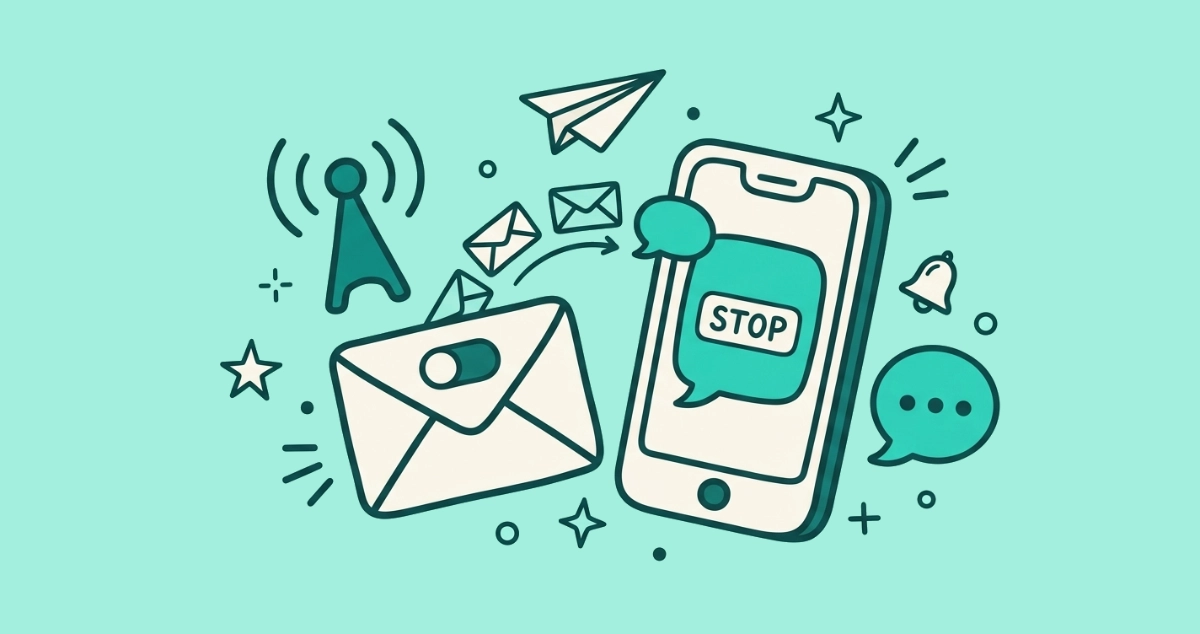
- Stop RCS business messages. Open the conversation in Google Messages, tap the menu, and choose Unsubscribe. The app sends a STOP on your behalf, and the sender must drop you from non-essential messages. Apple’s Messages offers a similar toggle on iOS 18. Google’s Unsubscribe button is live in the US, UK, France, Germany, India, Mexico, Spain, and Brazil.
- Stop SMS marketing. Reply STOP to the message. Under the FCC’s 2025 rule the sender has to honor it, and words like cancel, end, and unsubscribe count too. If STOP goes nowhere, an email or web-form request is equally valid.
- Stop WhatsApp marketing. Open the business chat, tap the business name, and choose Block, or use the option to stop messages. Meta requires businesses to get your opt-in first, so reporting one that never had it is fair game.
- Clear the email backlog. For the channel that still carries the most marketing, unsubscribe in bulk rather than one sender at a time.
The expected outcome is a phone that pings less and an inbox quiet enough to hear yourself think.
Where email still hands you the cleanest exit
Email stays the easiest marketing channel to clear in one pass, because the opt-out is standardized. Every bulk sender has to expose a one-click unsubscribe, so instead of hunting through settings across three apps, you can act on a whole inbox at once.
That is the job Email Unsubscriber does. It scans your Gmail or Outlook in your browser, lists every subscription sender in one place, and sends a real one-click unsubscribe where the sender supports it. Your email content never reaches a server, because we never read, analyze, or monetize it. You pay once, clear the backlog, and run a quick pass whenever it fills up again. It will not touch your texts or your WhatsApp chats. For the channel that still holds the most marketing, it turns a two-hour chore into a single sitting.
The takeaway
Marketing is spreading from your inbox to your DMs, and the trend is real. RCS crossed a billion messages a day in the US, WhatsApp has 3 billion users, and Apple’s iOS 18 handed brands the iPhone. Email is not dying through any of it. It remains the largest channel and the one with a standard, legal way out. The move to messaging gives you one more thing to keep tidy, not one less. Learn where each channel hides its exit, use it, and clear the inbox in bulk while you are at it.